Microwave Repair Walnut Creek
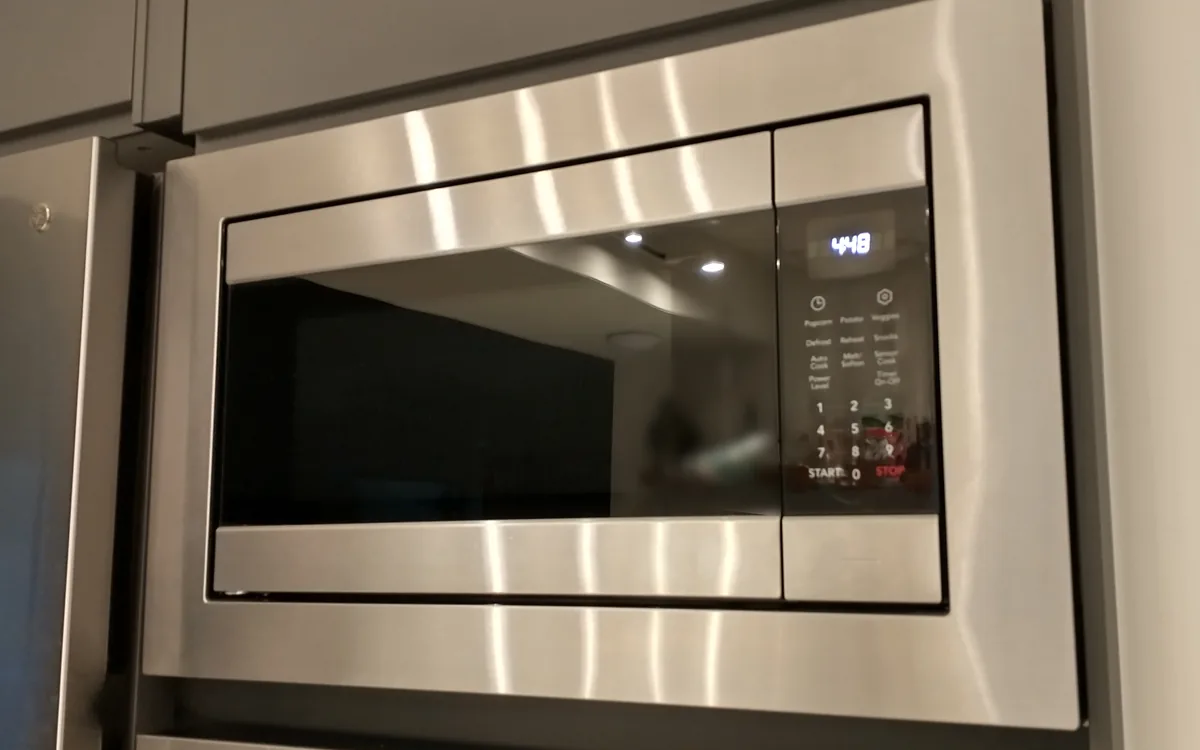
We repair built-in, over-the-range, drawer and speed microwaves — the installed units where replacement means matching a cabinet opening rather than buying a countertop box.
- Runs but does not heat, latch failures, dead control panels
- $99 service call — repair price quoted on site
- Same-day appointments, Monday to Friday
Service call $99. Repair price quoted on site.
Major Problems You Face with Microwave
Countertop microwaves are rarely worth repairing and we will tell you so. Built-in, drawer and over-the-range units are a different question entirely, because replacing one means matching a cabinet opening and a trim kit. Nearly all of what follows applies to those.
Microwave runs but does not heat
The high-voltage circuit: magnetron, high-voltage diode, capacitor or transformer. The diode is the most common single failure and the cheapest, so it is tested first. This circuit holds a lethal charge after the unit is unplugged, which is why it is not a home repair.
Loud buzzing while heating
Usually the high-voltage diode breaking down under load, or the transformer. A microwave that hums loudly and heats weakly is the classic diode pattern, and catching it early sometimes saves the magnetron.
Door will not latch or the unit will not start with the door shut
The door interlock switches. There are two or three in series by design, and one failing open stops the unit entirely. On drawer models the drive mechanism and its position switches do the same job and fail more often.
Control panel dead or keys unresponsive
The touch membrane or the control board. On over-the-range units heat rising from the cooktop below is a genuine cause, so we check the vent path before fitting a panel that would fail the same way.
Turntable will not rotate
The turntable motor, its coupler, or debris in the roller ring. Inexpensive, and worth doing because a stationary turntable produces the uneven heating that owners often mistake for a magnetron fault.
Sparking or arcing inside the cavity
Stop using it. Usually a burnt waveguide cover, damaged cavity paint, or food residue carbonized onto the ceiling. The waveguide cover is a cheap part, but arcing left alone will destroy the magnetron and damage the cavity.
Over-the-range fan not extracting
The blower, its capacitor or the filter. These units do two jobs, and the ventilation side fails independently of the microwave side. A greased-up filter is the first thing to rule out.
Drawer microwave will not open or close
The drawer drive motor, the belt or the position sensors. This is the most common fault on drawer models by a clear margin, and it is a mechanical repair rather than a high-voltage one.
Unit trips the breaker
A shorted transformer or capacitor, or a magnetron drawing far over its rating. We isolate the high-voltage section and test it off-circuit rather than resetting the breaker to see what happens.
Error code on a built-in or combination unit
Speed ovens and combination units log faults for the sensor, the door circuit, the fan and the inverter. On inverter models the fault set is different from a transformer machine, and we read the code against that manufacturer's documentation.
How We Repair Your Microwave
Heating confirmed with a measured load
A known volume of water, timed, with the temperature rise measured. That establishes whether the unit heats at rated power or is heating weakly, which are different faults.
High-voltage section discharged and tested
The capacitor is discharged before anything is touched, then diode, capacitor, transformer and magnetron are tested in order of likelihood and cost.
Door and interlock chain checked
Every interlock switch in the series, the latch geometry and, on drawer models, the drive and its position sensors.
Cavity and waveguide inspected
Waveguide cover, cavity paint and residue. Arcing damage is found here, and finding it early is what saves the magnetron.
Verified and leak-checked
The measured heating test is repeated, and we confirm the door seals and interlocks operate correctly before the unit goes back in its opening. The 3-month parts and 30-day labor warranty starts then.
Microwave Parts We Replace
Microwave repair concentrates in the high-voltage circuit and the door. The inexpensive items in that circuit fail far more often than the expensive one.
| Part | What it does, and how it fails |
|---|---|
| High-voltage diode | The most common no-heat cause, and the cheapest. Buzzes as it fails. |
| High-voltage capacitor | Shorts or goes open. Holds a lethal charge when unplugged. |
| High-voltage transformer | Shorts and trips the breaker. Heavy, and model-specific. |
| Magnetron | Produces the microwaves. Replaced last, after the cheaper circuit is cleared. |
| Door interlock switches | Two or three in series. One failed open stops the unit dead. |
| Door latch assembly | Wears so the latch no longer reaches the interlocks. |
| Turntable motor and coupler | Cheap, and it restores even heating. |
| Waveguide cover | Burns and then arcs. Inexpensive, and urgent once it starts. |
| Cooling fan motor | Protects the magnetron. Its failure shortens the magnetron's life. |
| Extraction blower and capacitor | Over-the-range units. Fails independently of the cooking side. |
| Drawer drive motor and belt | Drawer models. The single most common fault on that design. |
| Touch membrane and control board | Ordered per model. Heat from below is often the root cause. |
| Inverter board | Inverter models. Replaces the transformer and capacitor entirely. |
We fit manufacturer parts on built-in units as a rule, and the high-voltage components are not a place for approximations: a capacitor or transformer with different ratings changes how hard the magnetron is driven, and the cost of getting it wrong is the expensive part. Where a board, an inverter or a drawer assembly must be ordered, availability is confirmed from your kitchen and the date comes with the quote.
Microwave Brands We Service
Built-in, drawer and speed microwaves are most of this work, because those are the ones worth repairing. Each brand page covers that manufacturer's design and fault codes.
Luxury and Built-In
Microwave Repair Cost in Walnut Creek
The service call is $99, and it covers the trip and the diagnosis at your address. Beyond that we do not publish price ranges. The reason is worth stating plainly: a microwave that does not heat is a ten-dollar diode on one unit and a magnetron plus a transformer on the next, and until the high-voltage section is tested nobody can tell you which. A number quoted before anyone has seen the appliance would be a guess, and a guess that later moves is worse than no number at all.
Once the technician has found the fault you get one price for the whole job — parts and labor together, with the 3-month parts and 30-day labor warranty included — and nothing proceeds until you agree to it. If you decide against the repair, you pay the service call and nothing else.
What moves the price on this appliance
- Built-in, over-the-range or drawer. A built-in comes out of its trim kit and cabinet opening before anything can be reached; a drawer model has a drive mechanism no other design has.
- Which part of the high-voltage circuit failed. The diode, the capacitor, the transformer and the magnetron differ by a large factor in cost.
- Whether arcing has already caused damage. A burnt waveguide cover is cheap; a cavity damaged by prolonged arcing is not.
- Whether the ventilation side is also involved on an over-the-range unit, since that is a separate system in the same box.
- Whether the part is carried. Diodes, interlocks, turntable motors, waveguide covers and fan motors are on the van; magnetrons, inverters and boards are ordered.
When we will tell you not to repair it
On any countertop microwave, almost always — a new one costs less than the diagnosis plus the part, and we will say so rather than take the work. On built-in units, when the cavity is damaged by arcing, when a magnetron and transformer have failed together late in life, or when the door assembly is no longer supplied for the model.
Should You Repair or Replace Your Microwave?
The NAHB and Bank of America life expectancy study, published in 2007 on 2005 data, puts microwave ovens at 9 years for a first owner, tied with dishwashers as the shortest-lived major appliance in that table. We cite it with its date rather than as a current figure.
The working rule is the 50% rule: if the repair costs more than half the price of an equivalent new unit, and the appliance is already past the middle of its service life, replacement is usually the better spend. Two things bend that rule on this appliance. First, the economics are entirely different for built-in and countertop units. A countertop microwave is rarely worth a service call; a built-in or drawer unit sits in a cabinet opening with a trim kit, and replacement means matching both. Second, the parts that most often fail are the cheap ones in the high-voltage circuit, so a no-heat fault is frequently a small repair.
Signs that point to replacement
- It is a countertop unit. The repair rarely makes sense against the price of a new one.
- Arcing has damaged the cavity itself rather than just the waveguide cover.
- Magnetron and transformer have both failed on a unit past its ninth year.
- The door or latch assembly is no longer supplied for the model, since the interlocks are a safety system.
Same Day Microwave Repair Service Near Me in Walnut Creek
Built-in and drawer microwaves come with remodeled kitchens, which locally means the downtown condos and the newer builds more than the original single-family stock.
Contra Costa County
Alamo, Lafayette, Orinda, Pleasant Hill, Concord and San Ramon sit on the same weekday routes. Beyond Contra Costa we cover Alameda, Santa Clara, San Mateo, San Francisco and Marin counties from the same base.
Zip Codes We Serve in Walnut Creek
- 94595
- 94596
- 94597
- 94598
Microwave Repair Reviews
We do not publish written testimonials we cannot attribute. Our Google profile is the record, and the facts beside it are ones you can check.
What every call comes with
- $99 service call, covering the trip and the diagnosis. The repair price is quoted on site and you approve it before any work begins.
- 3-month parts and 30-day labor warranty on what we install, alongside the manufacturer’s own part warranty.
- Independent workshop, working since 2017. We are not an authorized agent for any manufacturer, and we do not claim to be.
- A Walnut Creek base at 130 Sharene Lane, so the common parts are already on the van and most jobs close in one visit.
How to Keep Your Microwave Running Longer
A microwave asks for almost nothing, and the few things it does ask for are the difference between a nine-year life and a much longer one.
Never run it empty
With nothing to absorb the energy it reflects straight back into the magnetron, and that is how magnetrons die early. The same applies to heating something very small: add a cup of water alongside it. This is the single most damaging habit there is with a microwave.
Keep the waveguide cover clean and intact
It is the small mica or plastic panel on the cavity wall or ceiling. Food residue carbonizes on it, and once it starts to burn it arcs, which will destroy the magnetron. Wipe it gently, and if it is scorched or holed, have it replaced before you use the unit again.
Cover food and wipe the cavity
Splatter on the cavity ceiling is where arcing starts. Covering dishes takes almost no effort and it keeps the cavity paint intact, which matters because damaged paint is not something that can be tidily repaired.
Clean the grease filter on an over-the-range unit
The mesh filters slide out from underneath and go in the dishwasher. A greased filter cuts extraction, and it also lets grease carry into the blower housing. This is also the cheapest way to stop heat and grease reaching the control panel above.
Do not slam a drawer model
Drawer microwaves open and close on a motorized drive with position sensors, and that mechanism is the most common thing to fail on the design. Let it do the work; pushing or pulling the drawer against the drive is what wears the belt and the sensors.
For running costs and efficiency, the federal guidance at energy.gov is the neutral source.
Microwave Repair FAQ
My microwave runs but does not heat. Is it finished?
Often not. The high-voltage circuit has four main parts and the cheapest of them, the high-voltage diode, is the most common failure. We test the circuit in order of likelihood and cost, so the magnetron — the expensive part — is what we conclude last rather than first. If it does turn out to be the magnetron on an older unit we will tell you plainly whether it is worth doing.
Should I repair a countertop microwave?
Usually not, and we would rather say so on the phone than take your money. Between the service call and the part, a repair on a countertop unit generally costs more than a replacement. Built-in, over-the-range and drawer microwaves are a completely different calculation, because replacing one means matching a cabinet opening and a trim kit.
There is sparking inside the microwave. Can I keep using it?
No — stop and unplug it. Arcing is usually a burnt waveguide cover or carbonized residue on the cavity ceiling, and the cover itself is a cheap part. What makes it urgent is that continued arcing destroys the magnetron and can damage the cavity, which turns a small repair into a replacement.
Why has my drawer microwave stopped opening?
The drive mechanism: the motor, the belt or the position sensors. This is the commonest fault on drawer models by a wide margin, and it is a mechanical repair rather than anything to do with the high-voltage side. It is also usually repairable, which matters given what these cost to replace.
Can I replace the high-voltage parts myself?
Please do not. The high-voltage capacitor holds a charge capable of killing you after the unit is unplugged, and it does not discharge on its own within any safe timeframe. Discharging it correctly is the first step of every microwave diagnosis we do, before anything inside is touched.
The extraction fan on my over-the-range microwave has stopped. Is that the same repair?
No, it is a separate system in the same cabinet, and it fails independently of the cooking side. Start with the grease filters, because a clogged filter accounts for a lot of these complaints. Beyond that it is the blower motor or its capacitor, and it is a much simpler job than anything in the high-voltage circuit.
Do you repair speed ovens and combination microwave-convection units?
Yes. These log faults differently from a plain microwave and often use an inverter rather than a transformer and capacitor, so the fault set is not the same. We read the stored code against that manufacturer's own documentation instead of a generic list, since the same number means different things across brands.